Sep 11, 2026
I moved to Barcelona
Four years ago, on my first morning in Barcelona, I did something I had never done until that point. I joined a walking tour.
Somewhere between the Gothic Quarter, the Roman ruins beneath the streets and stories of a region with a fierce memory of its own, Barcelona had me hooked. I fell in love with its architecture and discovered an interest in history I had never known I possessed. The dense, complicated history of Barcelona and Catalunya had me hooked.

That trip planted an idea in my head: I wanted to experience living in Europe.
Over the next four years, the idea became a plan, the plan became an obsession, and the obsession eventually became sleepless nights, stress of what will happen next and a one-way flight ticket.
Four months ago, I moved to Barcelona.
Why did I leave India?
I was deeply unhappy with the quality of life I had in India.
This is not an argument that India is uniquely terrible or that Europe is flawless where everyone spends their afternoons reading philosophy beside a fountain. Every place has problems. Moving countries is largely the process of choosing which problems you are willing to tolerate.
There was the energy-sucking traffic of Bangalore. The lack of places where you could simply exist without needing to buy something. The difficulty of walking anywhere safely in a city where walking happened to be one of my favourite things to do. The poor infrastructure, the lack of general safety, the pollution, and the age old frustration of paying a significant amount in taxes while receiving very little or nothing in return.
But the problems themselves were only part of it. What affected me more was the growing conviction that many of them would not meaningfully improve within my lifetime. I did not want to spend another decade complaining about the same roads, the same pavements that disappeared without warning, the same forty-minute journey that should have taken ten.

I had decided, on several occasions, to remain in India. There were good reasons to stay. I understood how everything worked, or at least how to work around the things that didn’t.
Leaving was not an easy or obvious decision.
But eventually, staying began to feel less like a decision and more like something I continued doing because I had already spent a lifetime there.
I had lived in Bangalore for almost my entire life. For years, it was the only Indian city in which I could imagine building a life. Goa occasionally tempted me, because of how beautiful and simple life felt there, but it did not fully align with the career or life I wanted.
And Bangalore itself had become increasingly unfamiliar.
I watched the city I grew up in transform into something I barely recognised. The uniqueness of places and restaurants was replaced with commoditized brands. Roads grew more crowded. Journeys became more exhausting. The rhythms of the city changed, and somewhere along the way, I stopped feeling at home.
I kept hoping to return to an earlier version of Bangalore, the one preserved in memory, where the summers were kinder, stepping out of home did not feel like an exhausting ritual, and the city still felt like a calm retiring city with trees on either side.
But that home no longer existed. Perhaps it had never existed in quite the way I remembered it.
There is a particular sadness in falling out of love with the city that raised you. Nothing dramatic happens. You simply notice that the affection has been replaced by exhaustion.
I needed a change. Not a temporary escape followed by the same Monday morning. I wanted the disorientation of a new city, the humility of having to learn how everything worked again, and the possibility of falling in love with a place whose faults I did not already know by heart.
Why Barcelona?
For almost four years, I tried to find a way into Europe.
Initially, I took the straightforward route: apply for jobs at European companies and hope that one of them would be willing to relocate me as well.
Then the job market had fundamentally changed with AI. Finding a role abroad was already difficult. Finding one that would also sponsor relocation became much harder.
Many companies appeared to have concluded that instead of moving someone from India to Europe, they could simply open an office in Bangalore and keep everyone exactly where they were.
So I began looking at digital-nomad visas.
Portugal was my original choice. On paper, it seemed dreamy. In practice, the bureaucracy appeared so unreliable that moving there felt like placing my future in the hands of a system that might simply forget I existed.
Spain seemed more practical.
And Barcelona was where the whole desire had started. Coming back to live here felt almost suspiciously appropriate, as though the story had been circling the same point for four years and had finally decided to land.
Of course, visiting a city and living in it are different activities.
A lot of places are wonderful for four days. You eat well, walk through attractive streets, have two excellent glasses of wine and announce, with the confidence of someone who has never spoken to a local authority who doesn't speak the same language as you, “I could live here.”
Barcelona felt different. Even as a visitor, I could imagine the ordinary parts of life here. Buying groceries. Working from a neighbourhood café. Going for a walk after dinner. Having a favourite bar. Learning and speaking Spanish.
It felt creatively stimulating without feeling like a city that existed only for work. I loved its neighbourhood life: the bakeries, markets, plazas, tiny bars and familiar faces that make each part of the city feel like its own small town.
The city has the sea on one side and mountains on the other. There is beauty here, but also utility. Barcelona was not merely somewhere I wanted to look at. It was somewhere I could imagine constructing a life.

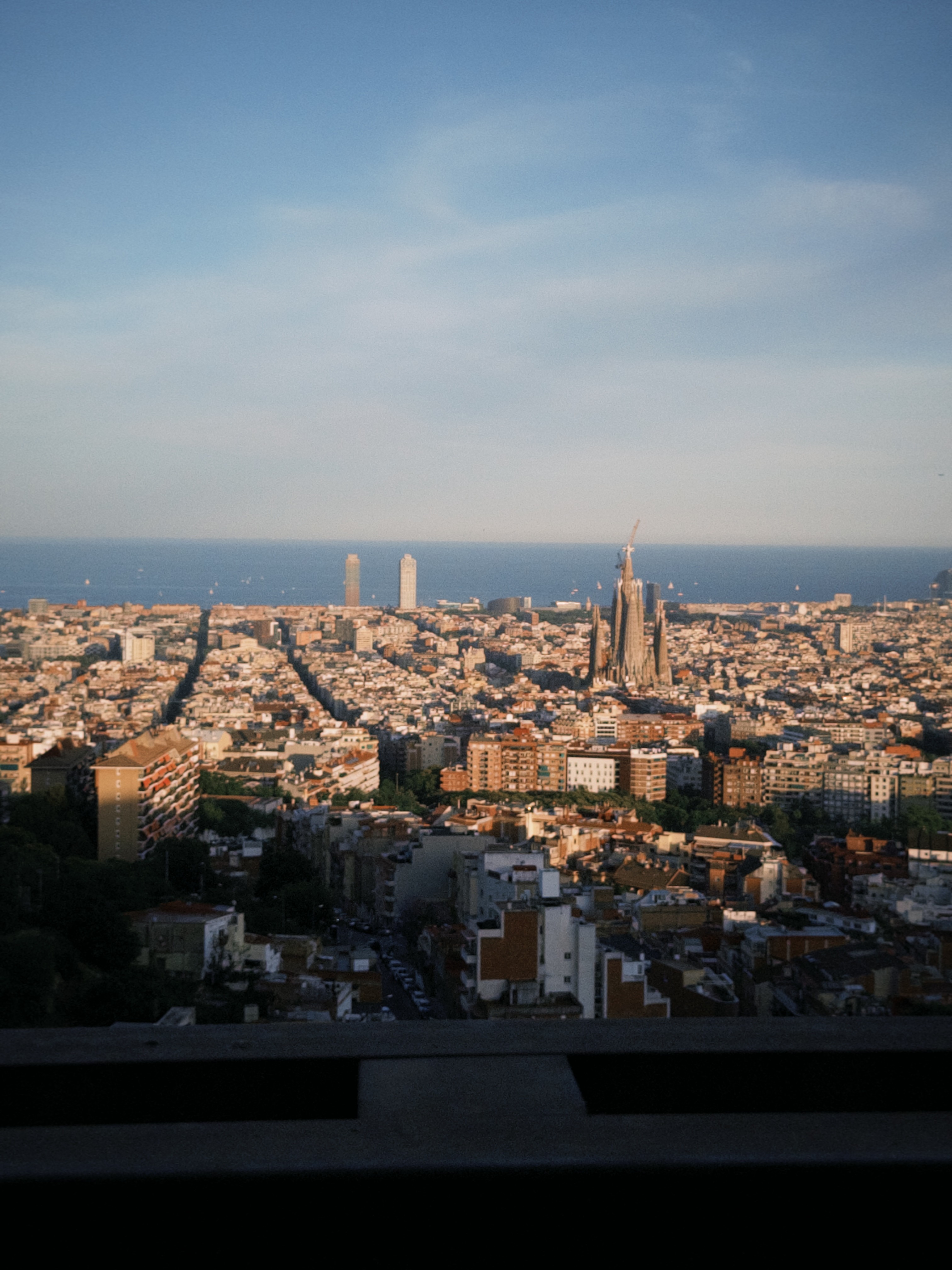
After living here for four months, I have also discovered something I could not have fully understood before moving: there seems to be a place for almost everyone.
You can party until six in the morning or wake up at six to run along the beach. You can spend Saturday at a club, on a mountain, inside a bookshop, at a life-drawing session, or discussing a niche topic with twelve people who are alarmingly excited about it.
Whether you like reading books or writing them, football or photography, electronic music or silent meditation, there is probably a community already meeting somewhere within a twenty-minute metro ride.
That mattered to me because one of my greatest fears was having to rebuild my social life from scratch.
Barcelona has a large community of immigrants, expats, temporary residents, long-term residents, and people who arrived for six months three years ago. Many of them understand what it means to start over. They know the awkwardness of having no history in a place and the relief of finding people with whom you do not need one.
People have generally been open and welcoming. Friendships form quickly because so many people are actively looking for connection.
It has also been refreshing to meet people whose identities are not entirely organised around their jobs.
I came from an environment where conversations often seemed to become an inventory of professional achievements: where do you work, what are you building, what are you building next? Barcelona has introduced me to people who are designers, engineers, musicians, teachers, photographers, set designers, painters and occasionally several of these things at once.
It has helped me become more curious about the whole person in front of me, rather than instinctively reducing them to their career.
Four months is far too early to make grand declarations. I am still in the phase where an ordinary walk can feel cinematic. Barcelona has problems, housing is brutally expensive, bureaucracy remains bureaucracy, and the city is not always delighted by the number of foreigners who have decided they also belong here.
But I did not move because I thought Barcelona would be perfect.
I moved because its imperfections seemed like ones I could live with.

How did I move?
I moved through Spain’s Digital Nomad Visa.
I entered Spain on a tourist visa and applied from within the country. In my case, applying from Spain meant receiving a three-year residence authorisation rather than the shorter initial authorisation available through the consular route.
The process involved a huge quantity of paperwork: employment records, financial documents, certificates, translations, apostilles, forms, declarations and various pieces of evidence designed to establish that I was a legitimate professional.
One advantage of the process was that the administration was required to respond within twenty working days. So I knew that I would not be stuck in the country with an endless wait time. After all the hoops, additional documents and anxious email-refreshing, the decision arrived within the promised window.
I worked with Moviinn as my immigration agency, and they were brilliant and reliable throughout the process. They helped me understand what was required, reviewed the paperwork and guided me through each step when I was too close to the situation to think clearly.
It is tempting to tell this as a story of individual grit: I made a plan, fought the bureaucracy and got myself to Barcelona. It is also bullshit.
People took calls and explained how they had found their own way abroad. Friends endured years of rants, false starts and increasingly unlikely plans. An incredibly supportive hiring manager helped make the whole thing possible, while equally supportive coworkers made space for the chaos that came with trying to move countries without letting everything else fall apart. And when immigration suddenly demanded more paperwork, my brother and sister-in-law got the documents apostilled at a speed I did not know was possible.
I may have boarded the flight alone, but I did not get here by myself.
That said, Digital Nomad Visa applications vary considerably depending on your nationality, employment structure, professional history and tax situation. Advice from someone who successfully received the visa can be useful, but it should not be mistaken for legal advice. Their application may look nothing like yours.
Speak to a qualified immigration professional before making expensive decisions based on a stranger’s confident Instagram carousel.
And the decisions will become expensive.
The visa application is only the beginning. There are agency fees, translations, apostilles, flights, temporary accommodation, deposits, advance rent, insurance, administrative costs and the unpleasant business of furnishing a home.
Moving abroad is often presented as a courageous leap into the unknown. Financially, it can feel more like being pushed down a staircase while people collect money from you on every step.
I spent a substantial portion of my life savings getting here and setting up a life. Anyone considering the same route should arrive with far more savings than they think they will need. The first few months are full of costs that appear individually reasonable and collectively horrifying.
There is also the emotional cost.
You leave behind competence. In your home country, you know which app to use, whom to call, how to pay a bill, what a shop sells and what a bureaucratic instruction probably means. In a new country, buying the correct dustbin can become a full blown research project. A government website can ruin an afternoon. A missed IKEA delivery can leave you sleeping on the floor, composing increasingly hostile emails and asking AI to translate them into something resembling diplomatic Spanish.
Starting over is exciting because everything is new.
Starting over is exhausting for exactly the same reason.
Was it worth it?
So far, yes.
Not because every day has been extraordinary. Most days are deliberately ordinary. I work. I buy groceries. I assemble furniture badly. I learn which streets are quieter, which cafés are overpriced and which supermarket never seems to have the thing I need.
But my ordinary life has changed.
There is a particular view I get almost every time I come out of the metro near my apartment. Trees line both sides of the avenue, traffic moves through the middle, and smaller service roads run alongside it beneath the buildings. It is busy, wide and unmistakably urban. Nothing particularly remarkable is happening. People are going to work, buses are stopping, scooters are weaving through traffic. Barcelona is simply carrying on with its day.
And almost every time I see it, I have the same stupidly sentimental thought: I cannot believe I get to live here.
Perhaps that will disappear. Familiarity is very good at turning miracles into infrastructure. But four months in, it still catches me off guard. I come out of the metro, look down that street and, for a few seconds, feel extraordinarily lucky.

That is probably as close as I can get to knowing I made the right decision.
I did not leave India because I hated everything about it. I left because the life available to me there no longer felt like the life I wanted.
And I did not move to Barcelona because I believed it would solve everything. A city cannot fix you, and changing countries does not allow you to leave yourself at baggage claim.
Four years ago, this city showed me the outline of another possible life.
Eventually, I decided to find out whether I could make it real.
If you’d like to receive new posts in your email inbox. Subscribe.